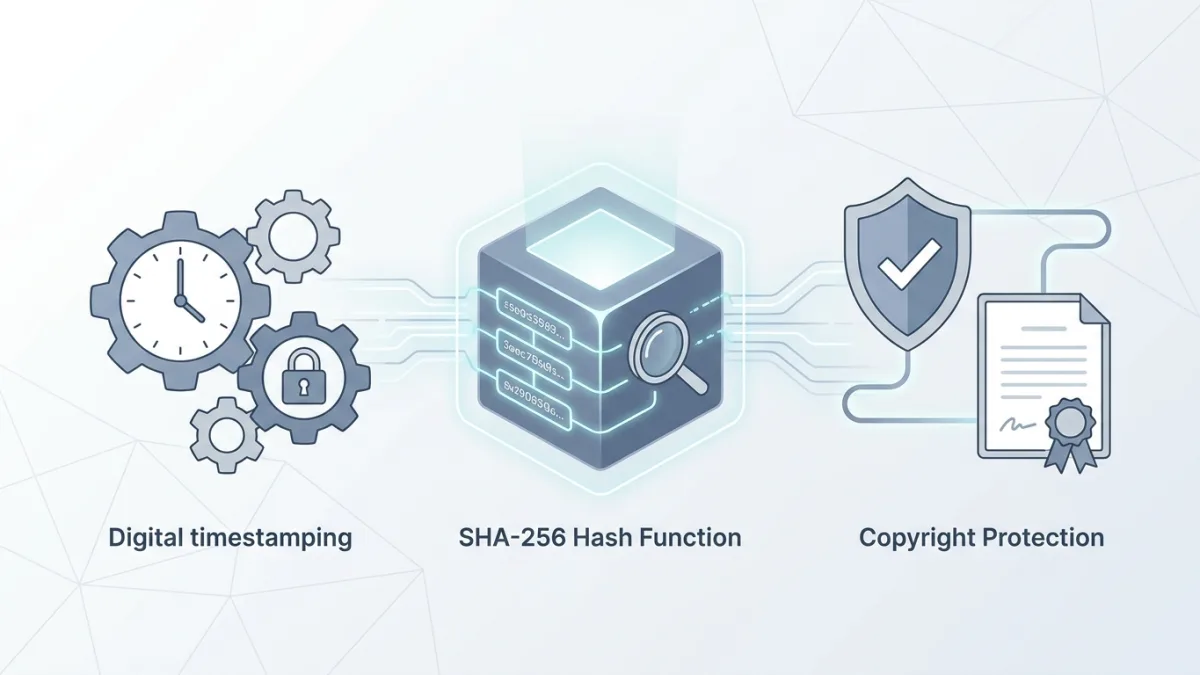
Learn how digital timestamping provides strong proof of prior existence for your creations. Secure your intellectual property and defend your rights online.
In the fast-paced world of digital creation, sharing your work online exposes you to a significant risk: content theft. Whether you are a freelance designer, a software developer, or a content creator, establishing clear ownership is crucial. This is exactly where digital timestamping comes into play. By generating a precise, secure record of when your work was created, digital timestamping provides robust proof of prior existence. If someone copies your design, steals your source code, or reuploads your video, having documented evidence of the exact date and time you possessed the file can make all the difference in a dispute.
Establishing this priority is the foundation of intellectual property protection. If you are wondering Why register your copyright?, the answer lies in securing this vital evidence before sharing your work with the world. You can easily start protecting your portfolio today when you Create a free account and take advantage of an accessible, modern registration system.
Understanding Proof of Prior Existence
When a copyright dispute arises, the core question rarely revolves around the quality of the work; instead, it focuses on a simple timeline: who created it first? Establishing this timeline is known as proving prior existence.
What Does Prior Existence Mean?
Prior existence is the factual demonstration that a specific piece of work existed in your possession at a specific date and time, prior to anyone else claiming it. In intellectual property, ideas themselves are not protected; only the tangible expression of those ideas is covered. Once your idea is fixed in a tangible medium—such as a text document, a recorded audio file, or an image—it becomes a creation subject to copyright.
💡 Tip: Always document the evolution of your work. Keeping drafts, sketches, and early versions alongside your final registered deposit strengthens your overall claim of original authorship.
Understanding the nuances between different legal frameworks is also beneficial. For instance, exploring the Authors Rights and Copyright Differences can help you grasp how your work is treated depending on your geographic location and local legal traditions. Regardless of the specific framework, the necessity to prove when the work was created remains a universal requirement.
Why Creators Need Evidence of Creation
Without clear evidence of creation, defending your work becomes a matter of your word against theirs. Plagiarists often rely on the fact that independent creators fail to secure their assets before publishing them on social media or delivering them to clients.
By establishing a verifiable date of creation, you shift the balance of power back to your side. This evidence acts as a powerful deterrent against potential infringers and provides a strong foundation for taking action if a conflict occurs.
How Digital Timestamping Works
Modern copyright protection relies on advanced technological processes rather than outdated physical mail systems. Digital timestamping offers a highly secure and efficient way to lock in the date and time of your creations.
The Technology Behind the Process
When you upload a file—be it text, image, audio, video, or source code—the system generates a unique digital fingerprint of that exact file using a SHA-256 hashing algorithm. This fingerprint is a long string of characters unique to your specific file. Even the smallest change to the file would result in a completely different fingerprint.
This fingerprint is then combined with a precise digital timestamp. To ensure the privacy and safety of your actual files, they are protected using server-side AES-256 encryption. This modern approach is vastly superior to older, traditional methods. If you compare a Soleau Envelope vs Modern Free Copyright, you quickly see that digital solutions offer faster processing, broader format support, and far more convenience.

Generating Your Certificate
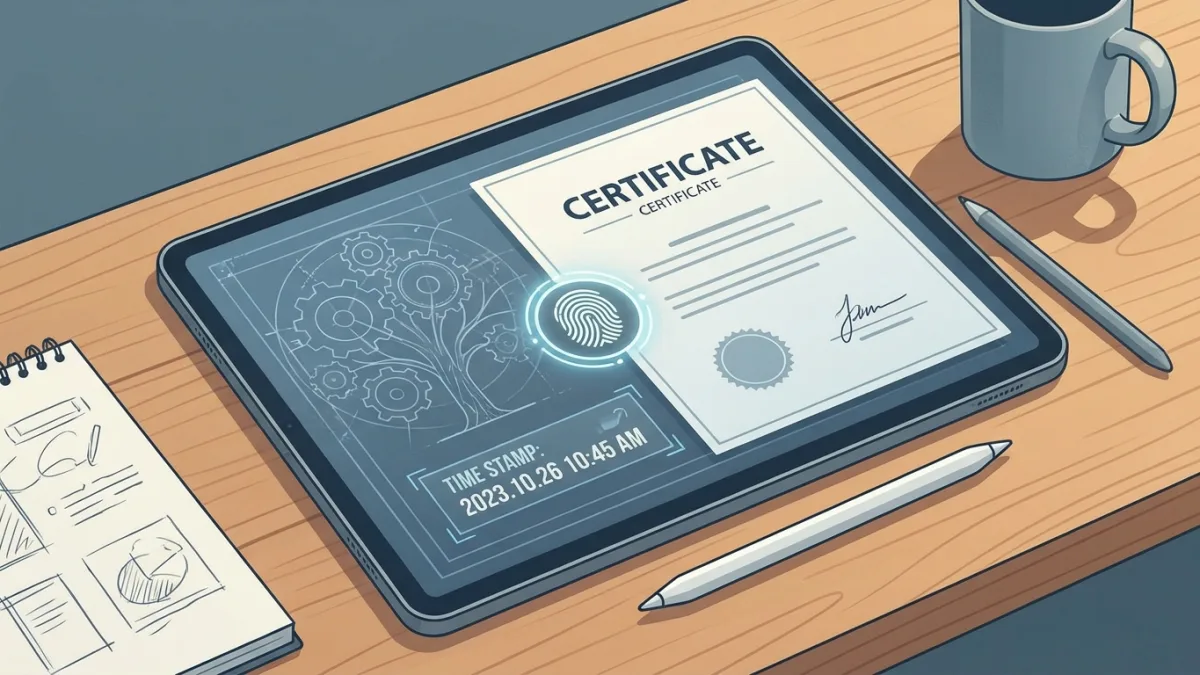
Upon successful registration, you receive a detailed PDF certificate. This document contains the SHA-256 fingerprint, the digital timestamp, and the details of your deposit.
📋 Key takeaway: Your PDF certificate is your main tool in a dispute. Keep it accessible, as it contains the exact digital fingerprint linking your stored file to the established date.
Furthermore, anyone can Verify a certificate using the unique reference numbers provided. This transparency is reinforced by the Public deposit registry, which allows third parties to confirm the existence and date of the registration without accessing the encrypted private files.
Global Protection Under the Berne Convention
One of the greatest advantages of establishing proof of prior existence is its international applicability. The internet has no borders, and your content can be accessed—and stolen—from anywhere in the world.
International Copyright Standards
Copyright arises automatically upon creation across the globe, largely thanks to the Berne Convention. This international treaty ensures that works created in one member state are recognized and protected in 181 countries.
However, while the protection is automatic, the proof is not. You must still be able to prove that you are the original creator. A robust digital timestamp serves as recognized evidence across these jurisdictions. Whether a company in Asia uses your logo or a website in South America reposts your article, your evidence remains highly relevant.
Recent legislative updates also emphasize the importance of protecting creators online. For example, understanding the EU Copyright Directive 2019/790 Explained highlights how platforms are increasingly held accountable for hosting infringing content, making your documented proof more valuable than ever when requesting takedowns.
Securing Work Before Publishing
To maximize the effectiveness of this international framework, you must register your work before you publish it. Your deposits are preserved for a minimum of 10 years, providing a long-term safety net for your intellectual property.
Copyright01 makes this highly accessible. You start with 3 free deposits to test the system. After that, you can purchase credit packs starting from just EUR 4.90, or opt for a comprehensive subscription at EUR 9.90/month or EUR 79/year for ongoing protection of your expanding portfolio.
Common Types of Works to Timestamp
Digital timestamping is highly versatile. It is not limited to traditional books or paintings; it covers the full spectrum of modern digital creations.
Digital Content and Social Media
Content creators invest hours into producing engaging media. You can register various types of files, including YouTube videos, Instagram posts, Facebook updates, X (Twitter) threads, and TikTok clips.
| Type of Work | Common Theft Scenario | How Timestamping Helps |
|---|---|---|
| Images & Photography | Downloaded and used on commercial blogs without credit. | Provides the original file fingerprint prior to the publication date. |
| Video Content | Reuploaded to competing channels to siphon ad revenue. | Establishes priority, speeding up platform takedown requests. |
| Written Articles | Scraped and republished by automated content farms. | Proves original authorship, supporting search engine de-indexing. |
| Source Code | Copied into competing commercial software products. | Documents the exact state of the code at a specific development milestone. |
Source Code and Freelance Projects
Developers and freelancers face unique risks. Sharing code or delivering a project to a client before receiving payment can lead to exploitation.
Developers should regularly consult the Open Source Copyright Guide for Developers to understand how to manage rights when sharing repositories on platforms like GitHub. Similarly, independent contractors must Protect Your Freelance Work Before Delivery. Timestamping your final deliverables ensures that if a client uses your work without paying the invoice, you have clear evidence that the work originated from you at a specific time.
⚠️ Warning: Never send high-resolution files or uncompiled source code to a new client without first securing a digital timestamp of those exact files.
Defending Your Rights in Copyright Disputes
Having proof of prior existence is only the first step; knowing how to use it when your rights are violated is the crucial second half of the equation.
Taking Action Against Theft
When you discover that someone has stolen your work, you must act swiftly. Avoid the 5 Fatal Online Copyright Deposit Mistakes, such as waiting too long to gather evidence or sending aggressive, unstructured emails to the infringer.
Instead, use your PDF certificate to enforce your rights through formal channels. For visual works, you can efficiently Remove Stolen Images With a DMCA Takedown by attaching your proof of prior existence to the notice sent to the web host. If your audiovisual content is reuploaded, follow the specific steps to How to Remove a Stolen YouTube Video Fast.
Resolving Online Conflicts
Sometimes, the infringement is broader than a single image or video. Entire websites might be scraped and cloned. In these severe cases, knowing How to Shut Down a Website Copying Yours is essential. Your timestamped records of your website's source code, text, and structure serve as the foundation for your legal requests to hosting providers and domain registrars.
Ultimately, Winning Your Copyright Dispute Online comes down to preparation. Platforms, hosts, and legal professionals respond to clear, documented evidence. By proactively utilizing digital timestamping, you transform a potentially stressful confrontation into a straightforward process of presenting your established proof.
Protecting your creative output doesn't have to be complicated. By integrating digital timestamping into your regular workflow, you ensure that every new design, article, track, or line of code is securely documented. Take control of your intellectual property today and build a resilient portfolio backed by clear evidence of prior existence.
Copyright01
Free copyright protection service. PDF certificate with SHA-256 fingerprint, recognised in 181 countries.