Learn how an audio copyright deposit can protect your podcast from theft. Establish prior existence and secure your creative work across 181 countries.
Podcasting has exploded into one of the most popular and influential mediums for creators, journalists, and entertainers to share their voices with a global audience. However, as the industry expands and monetization opportunities grow, so does the risk of intellectual property theft. If you spend countless hours researching, recording, and carefully editing your episodes, you need to know how an audio copyright deposit can safeguard your hard work. Protecting your podcast is no longer just an optional administrative task; it is a fundamental pillar of professional content creation.
In this comprehensive guide, we will explore exactly how you can secure your audio files, establish recognized proof of prior existence, and defend your creative assets against unauthorized use. From understanding international intellectual property laws to issuing takedown notices, this article will equip you with the knowledge required to keep your podcast safe.
The Urgent Need for Podcast Copyright Protection
The Growing Threat of Audio Plagiarism
When a podcast begins to gain traction and build an audience, it naturally attracts attention. Unfortunately, not all of this attention is positive or ethical. Plagiarists and content scrapers frequently target popular shows. They might steal specific audio clips to use without permission, transcribe your spoken episodes to publish as their own SEO-optimized blog posts, or even re-upload your entire episodes to different platforms under a fake name to siphon away your advertising revenue.
Furthermore, the rise of artificial intelligence has introduced new threats, such as unauthorized AI voice cloning, where bad actors replicate a host's voice to generate fake content. If you are wondering Why register your copyright?, the answer is simple: relying solely on the automatic rights granted to you upon the creation of a work is often insufficient when you are forced into a position where you must prove you were the original creator.
Understanding Your Intellectual Property Rights
To effectively defend your creative output, it is vital to grasp the foundational basics of intellectual property. A podcast is a highly complex creative work that involves multiple layers of rights. The spoken words, the musical intro, the interview format, and the final audio mix all contribute to the uniqueness of your show.
Navigating these layers requires an understanding of how different jurisdictions view creative ownership. For instance, understanding the Authors Rights and Copyright Differences can help you comprehend how your work is treated in European civil law systems versus Anglo-American common law systems.
💡 Tip: Always keep your original, unedited raw audio files stored safely. These raw files serve as excellent supporting evidence alongside your formal registration when you need to demonstrate your creative process.
How an Audio Copyright Deposit Safeguards Your Show
The Power of Establishing Prior Existence
The core of almost any intellectual property dispute comes down to a single question: who created the work first? This is precisely where an audio copyright deposit provides immense value. By registering your podcast episode before you publish it to RSS feeds or streaming platforms, you secure an objective date of creation.
As explained in our guide on How Digital Timestamping Protects Creators, a digital timestamp links your specific audio file to a precise, verifiable moment in time. This creates strong evidence that your work existed in its completed form before any plagiarist had the opportunity to copy it.
In the past, creators relied on outdated and less effective methods to prove creation dates. Today, understanding the difference between a Soleau Envelope vs Modern Free Copyright reveals why digital solutions are vastly superior for fast-paced digital media like podcasts.
International Reach Through the Berne Convention
Podcasts are inherently global. An episode uploaded from a studio in London can be downloaded by a listener in Tokyo a second later. Because your content crosses borders instantly, your protection must do the same.
Fortunately, your registration offers extensive international reach. Thanks to the Berne Convention, an international agreement governing copyright, your proof of prior existence is recognized in 181 countries. This means that if a creator in another participating nation steals your podcast format or audio, you have recognized evidence to challenge them across international borders.
Comprehensive Protection: What Elements Should You Register?
Audio Files, Raw Recordings, and Scripts
When securing a podcast, the most obvious asset is the final audio file. You can deposit the final mixed .mp3 or .wav file of your episode. However, if your podcast is highly scripted—such as a true-crime narrative or an audio drama—you should also protect the written document.
If you work with external editors, writers, or sound designers, it is crucial to ensure all rights are transferred to you. You should Protect Your Freelance Work Before Delivery and establish clear contracts regarding who owns the final audio assets.
Visual Branding and Show Notes
Your podcast's visual branding and supplementary text are just as important as the audio itself. A recognizable cover art image is how listeners identify your show on platforms like Apple Podcasts and Spotify.
| Podcast Element | Recommended Deposit Type | What it Protects |
|---|---|---|
| Final Episode | Audio Deposit | The complete mixed audio, voices, interviews, and sound design. |
| Episode Script | Text Deposit | The written narrative, structural format, and specific phrasing. |
| Cover Art | Image Deposit | The visual branding, custom logo, and artwork used on directories. |
| Show Notes | Text / Website Deposit | The supplementary written content, blog posts, and resource links. |
📋 Key takeaway: Do not limit your protection strategy to just the audio files. Secure every creative element of your podcast, from the written script to the visual cover art, to ensure comprehensive coverage against copycats.
The Step-by-Step Copyright Registration Process
Creating Your Deposit with Copyright01
Securing your podcast is a straightforward process when you use the right platform. You can easily Create a free account to begin protecting your episodes immediately.
Copyright01 offers a highly accessible pricing structure tailored specifically for prolific creators. When you sign up, you receive 3 free deposits to start. Once you have used those, you can purchase credit packs starting from EUR 4.90. For podcasters who release episodes weekly or daily, there is a cost-effective subscription available at EUR 9.90/month or EUR 79/year.
The platform supports a wide variety of deposit types beyond just audio. You can protect text, images, video, source code, websites, GitHub repositories, and content native to platforms like YouTube, Instagram, Facebook, X, and TikTok.
The Technology: SHA-256 Fingerprints and Digital Timestamping
When you upload your audio file to the platform, the system immediately generates a unique digital signature using a SHA-256 fingerprint. You can think of this fingerprint as the unique digital DNA for your specific podcast episode. Even the slightest alteration to the audio file would drastically change this fingerprint.
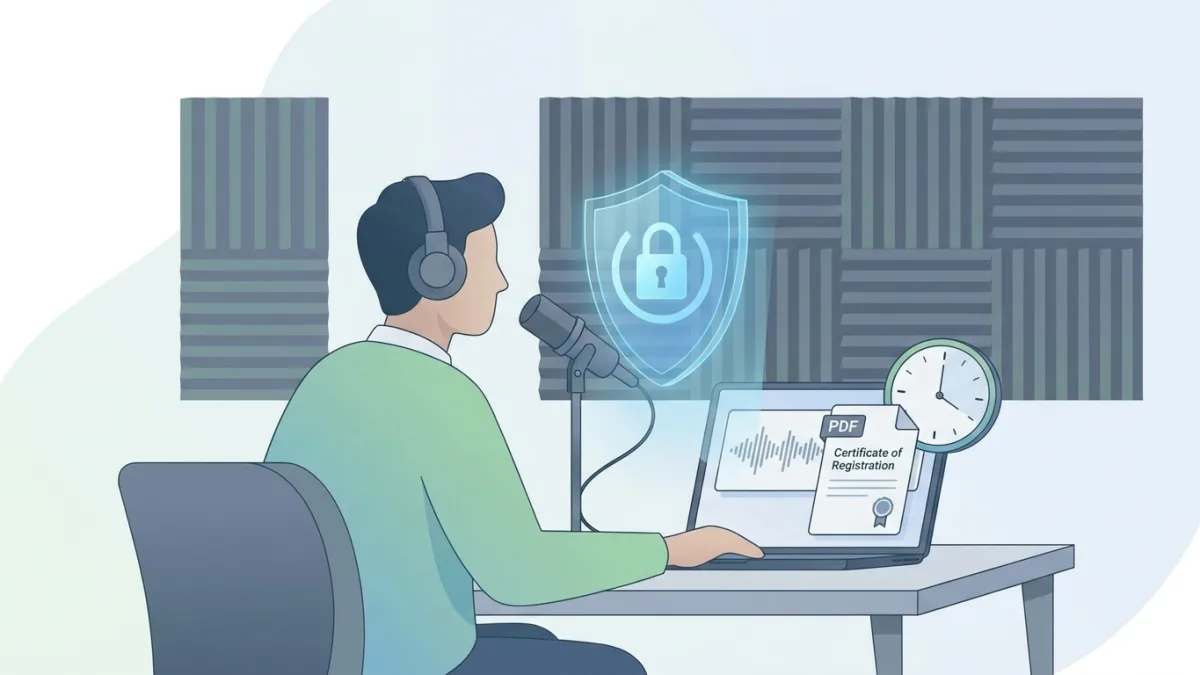
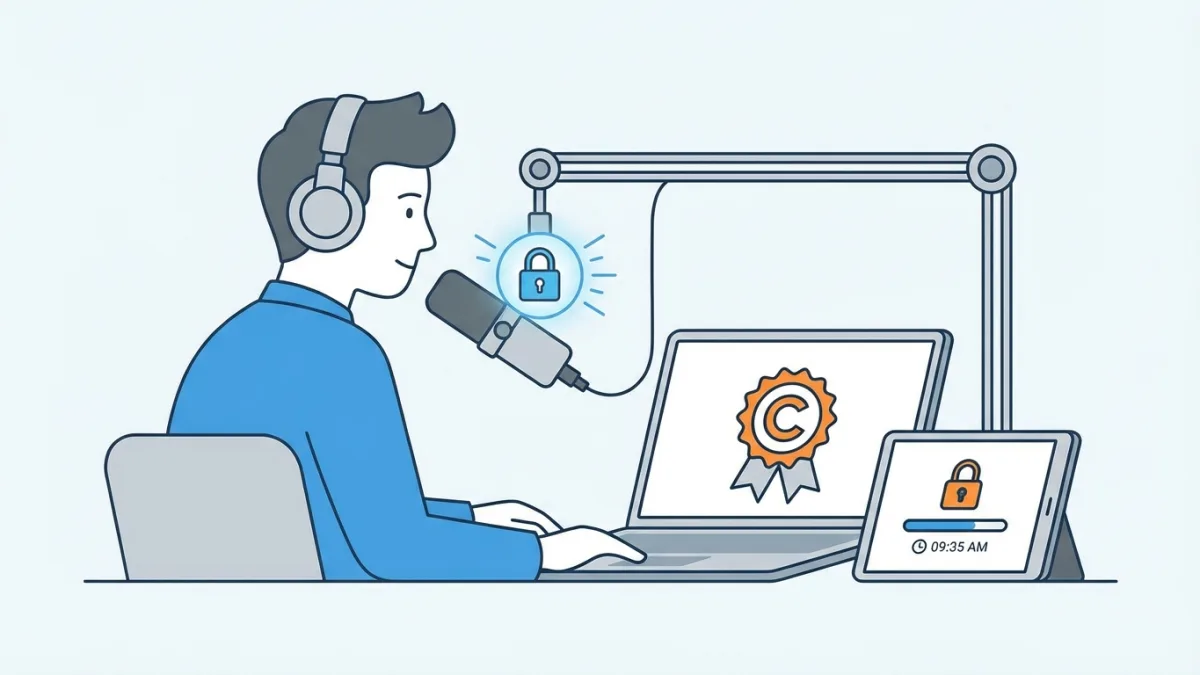
Combined with robust digital timestamping, this process provides exceptional evidence of your work's exact state at a specific second in time. Once the process is complete, you receive a detailed PDF certificate containing the SHA-256 fingerprint and the timestamp. Anyone you share this with can easily Verify a certificate using the platform's transparent verification tools.
Furthermore, all files uploaded to the platform are protected using strong server-side AES-256 encryption, and your deposits are preserved for a minimum of 10 years. For creators who want to publicly assert their ownership, there is also an option to list your work in the Public deposit registry.
⚠️ Warning: Be sure to avoid the 5 Fatal Online Copyright Deposit Mistakes, such as publishing your episode publicly before you have registered it, or losing access to the original source files.
Defending Your Podcast Against Unauthorized Use
Navigating Takedown Notices and Online Disputes
If you discover that someone has stolen your podcast audio, you must act swiftly and decisively. Audio platforms, hosting services, and search engines are required by law to respond to formal copyright infringement claims.
With your PDF certificate in hand, you have strong evidence to support a Digital Millennium Copyright Act (DMCA) takedown notice. Whether your audio was stolen and uploaded to a video platform—in which case you should learn How to Remove a Stolen YouTube Video Fast—or your cover art was copied, knowing how to Remove Stolen Images With a DMCA Takedown is an essential skill.
If a competitor has transcribed your podcast and published it as their own blog post, you can also take action to How to Shut Down a Website Copying Yours. Most copyright conflicts today happen entirely on the internet, which is why understanding the steps for Winning Your Copyright Dispute Online is crucial for modern creators.
Platform Liability and European Directives
It is also beneficial to understand how the legal landscape is shifting to favor creators. Platforms are increasingly being held responsible for the content their users upload. For podcasters with a European audience or those hosted on European servers, reading about the EU Copyright Directive 2019/790 Explained will provide valuable insights into how major tech companies are now obligated to proactively prevent the uploading of unauthorized copyrighted material.
By taking proactive steps to register your audio copyright deposit before publication, you position yourself with the strongest possible evidence to enforce your rights, maintain control over your creative output, and ensure that you are the only one profiting from your hard work.
Frequently Asked Questions (FAQ)
How much does it cost to secure my podcast audio?
With Copyright01, you receive 3 free deposits when you create an account. After that, you can purchase credit packs starting from EUR 4.90, or choose a subscription at EUR 9.90/month or EUR 79/year, which is ideal for podcasters with regular episodic releases.
Does my audio copyright deposit apply internationally?
Yes. Because of the Berne Convention, your proof of prior existence is recognized in 181 countries, offering robust global protection for your podcast content no matter where your listeners are located.
How long are my podcast audio files preserved?
Your audio copyright deposits, along with their associated digital timestamps and SHA-256 fingerprints, are securely preserved on the platform for a minimum of 10 years, ensuring long-term evidence of your creation.
Can I protect my podcast cover art and scripts too?
Absolutely. The platform allows you to register various file types. You can make a text deposit for your episode scripts and show notes, and an image deposit for your cover art and visual branding.
Copyright01
Free copyright protection service. PDF certificate with SHA-256 fingerprint, recognised in 181 countries.