Learn how to detect website plagiarism and assert your rights. Discover the best tools and steps to protect your content from online theft and infringement.
Creating high-quality, original content for your website requires significant time, effort, and financial investment. Unfortunately, the digital landscape makes it incredibly easy for unscrupulous individuals to copy and paste your hard work in a matter of seconds. If you want to detect website plagiarism and effectively assert your rights, you must implement a proactive and comprehensive strategy. Content theft is not just a minor annoyance; it can severely damage your search engine rankings, dilute your brand identity, and ultimately impact your bottom line. In this comprehensive guide, we will explore the various forms of online plagiarism, the best tools to identify stolen content, and the precise steps you need to take to protect your intellectual property.
Understanding Website Plagiarism and Its Consequences
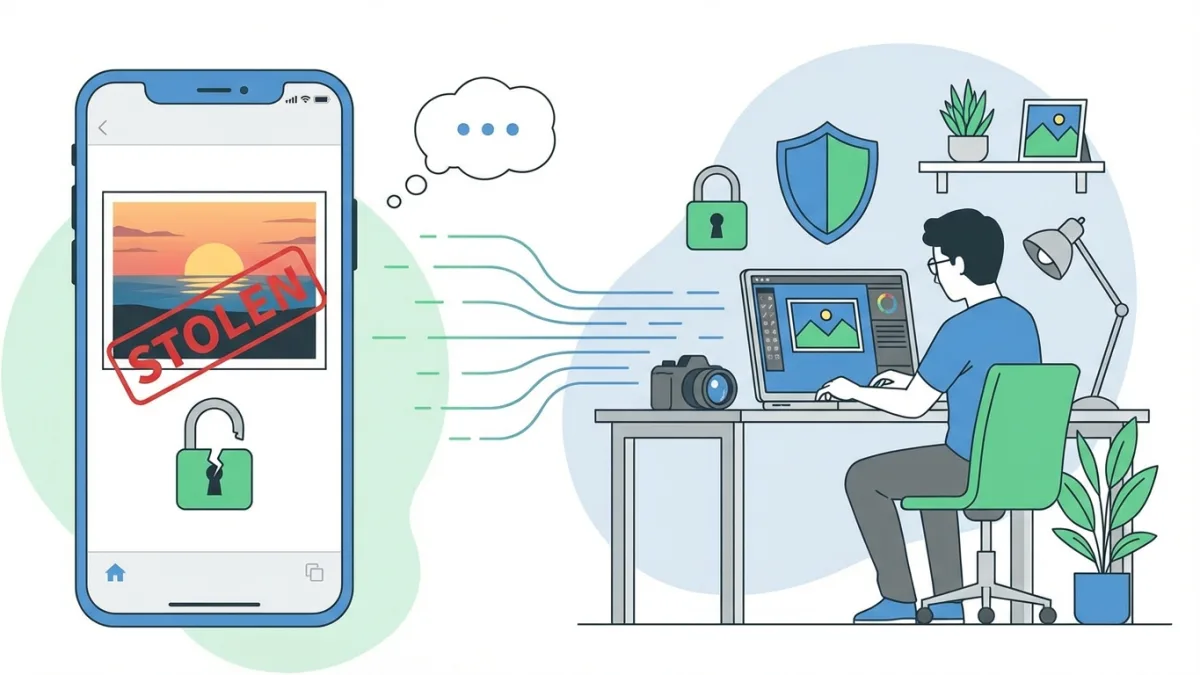
Website plagiarism goes far beyond simply copying a few paragraphs of text. In today's interconnected digital ecosystem, automated scraping bots and competitors might steal a wide array of your digital assets. Understanding exactly what constitutes plagiarism is the vital first step in defending your digital property.
The Various Forms of Digital Theft
When we think of plagiarism, written articles usually come to mind. However, website plagiarism encompasses much more across your digital presence:
- Textual Content: Blog posts, landing page copy, product descriptions, and "About Us" pages are frequently scraped and republished.
- Visual Assets: Custom graphics, infographics, logos, and photographs. If you are a creative professional, you might want to read our comprehensive guide on Copyright for Freelance Graphic Designers to understand how to secure your visual works.
- Multimedia: Audio tracks, podcasts, and video content are highly valuable. As multimedia becomes more prevalent, learning How to Protect Your Music in 2026 is crucial for creators.
- Source Code and Design: The HTML, CSS, JavaScript, and overall architecture of your website. Code theft is increasingly common, which is why developers must actively Protect GitHub Source Code and Repositories.
The Hidden Costs of Content Theft
The impact of stolen content extends far beyond the initial frustration of seeing your work on someone else's domain. Search engines like Google strive to provide users with unique, valuable information. When your content is duplicated across multiple domains, search engines may struggle to determine the original source. This can lead to severe duplicate content issues, potentially causing your original pages to drop in search rankings or lose their crawl budget priority.
Furthermore, if a competitor uses your exact product descriptions or marketing copy, they may siphon away potential customers who mistake their site for yours. Protecting your content is fundamentally about protecting your business revenue, maintaining your SEO visibility, and preserving your brand's reputation.
⚠️ Warning: Never assume that search engines will automatically know you are the original author. If a larger, more authoritative website steals your newly published content before search engines index your page, the thief might mistakenly be credited as the original creator.
Proven Methods to Detect Website Plagiarism
To stop content thieves, you first need to find them. Fortunately, several highly effective manual and automated methods can help you detect website plagiarism quickly and accurately before the damage spreads.
Manual Search Techniques
The simplest way to check for stolen text is by using search engines directly. Take a unique, specific sentence from your website—preferably one that contains distinct phrasing or unique data points—and paste it into Google enclosed in quotation marks. This forces the search engine to look for an exact match across its entire index.
If the search results display websites other than your own, you have likely found a plagiarist. While this method is free and straightforward, it is time-consuming and not scalable for large websites with hundreds of pages or frequently updated blogs.
Automated Plagiarism Checkers
For a more comprehensive approach, automated tools are absolutely essential. These platforms continuously scan the internet to find duplicate versions of your text. Some popular options include Copyscape, Grammarly's plagiarism checker, and various specialized SEO auditing tools. Additionally, setting up Google Alerts for your brand name or specific, unique phrases from your cornerstone content can notify you via email whenever your text appears elsewhere online.
With the rapid rise of artificial intelligence, detecting copied text has become significantly more complex. Some thieves use AI tools to spin or rewrite your content to evade basic detection. To understand how these new technologies impact your intellectual property rights, review our detailed insights on AI Content and Copyright Rules Explained.
Reverse Image Searching
Text isn't the only asset that gets stolen. To find out if your original images, charts, or infographics are being used without permission, utilize reverse image search tools like Google Images or TinEye. By uploading your image or pasting its URL, these tools will show you everywhere the image appears on the web, allowing you to track down unauthorized usage.

Comparing Detection Methods
| Detection Method | Cost | Accuracy | Best Used For |
|---|---|---|---|
| Exact Match Search | Free | High for specific phrases | Quick spot-checks on newly published articles |
| Automated Checkers | Low to Medium | Very High | Scanning entire websites and large text batches |
| Google Alerts | Free | Medium | Ongoing monitoring of brand names and key quotes |
| Reverse Image Search | Free | High for exact visual matches | Finding stolen photography and custom graphics |
💡 Tip: Make it a habit to run a comprehensive plagiarism check on your most valuable, highest-trafficking pages at least once a month. Early detection makes it significantly easier to mitigate the SEO damage.
The Crucial Role of Proof of Prior Existence
Detecting website plagiarism is only the first part of the battle. When you confront a content thief, submit a takedown request to a web host, or escalate the issue to search engines, you must be able to prove that you are the original creator. Without solid evidence, it becomes a frustrating scenario of your word against theirs.
Why You Need Solid Evidence
In the digital world, creation dates displayed on a blog post or a webpage can be easily manipulated. A plagiarist can simply backdate their stolen article in their Content Management System to make it appear as though they published it before you did. To successfully assert your rights, you need objective, third-party proof that your content existed at a specific point in time. For a deeper dive into the different ways to establish this crucial timeline, check out our article Comparing 5 Proof of Prior Existence Methods.
How Copyright01 Secures Your Rights
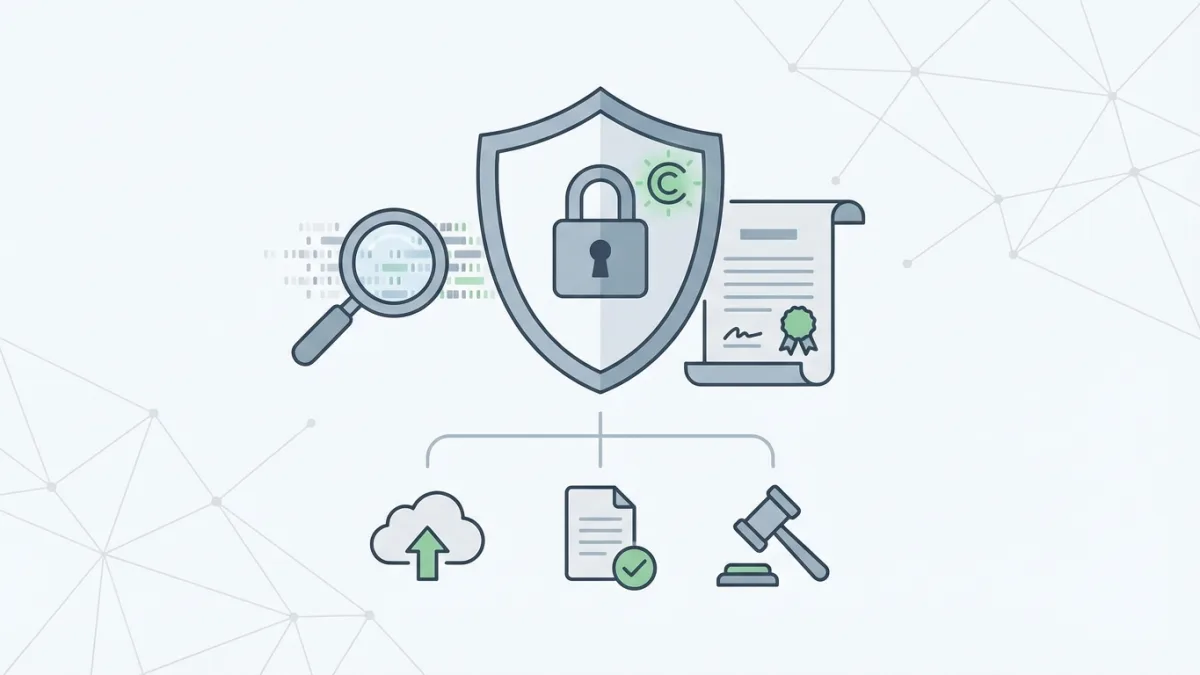
This is where a professional copyright registration service becomes indispensable. Copyright01 provides a streamlined, highly secure way to establish proof of prior existence for all your digital assets. Whether you are protecting text, images, audio, video, source code, or an entire website structure, the platform offers robust protection designed for the modern web.
When you register your work, you receive a detailed PDF certificate containing a unique SHA-256 fingerprint and a digital timestamping record. This technical process cryptographically links your file to a specific, verifiable date and time. The data is protected using server-side AES-256 encryption, ensuring your intellectual property remains private and secure from unauthorized access. Furthermore, all deposits are preserved for a minimum of 10 years, giving you long-term peace of mind and enduring proof of your creations.
You can start protecting your work immediately. Copyright01 offers 3 free deposits for new users, allowing you to test the system risk-free. After that, you can purchase credit packs starting from just EUR 4.90, or opt for a comprehensive subscription at EUR 9.90/month or EUR 79/year. Ready to secure your assets? Create a free account today. If you are unsure about the broader benefits of registration, read more about Why register your copyright?.
Global Protection Framework
One of the greatest advantages of establishing proof of prior existence is the international scope of your rights. Thanks to the Berne Convention, copyright protection is automatically recognized in 181 countries worldwide. This means that if a website hosted in another country steals your content, your Copyright01 certificate serves as recognized proof of your prior claim across international borders. Learn more about how this powerful treaty works in our guide to Berne Convention Global Copyright Protection.
📋 Key takeaway: A digital timestamp and a SHA-256 fingerprint provide objective, technical evidence of exactly when your content was created, making it significantly easier to enforce your rights globally.
Actionable Steps to Assert Your Rights
Once you have detected website plagiarism and secured your proof of prior existence, it is time to take decisive action. Asserting your rights requires a methodical, step-by-step approach to ensure the stolen content is removed promptly and permanently.
Step 1: Document the Infringement
Before you contact anyone or send any notices, gather your evidence. Plagiarists often panic and delete stolen content the moment they are caught, which can destroy your proof if you haven't documented the theft. Take high-resolution screenshots of the infringing pages, ensuring the URL and the system date are clearly visible. You should also use internet archive tools like the Wayback Machine to save a public, third-party snapshot of the stolen content as it appeared on their site.
Step 2: Contact the Website Owner
Often, content theft is the result of ignorance rather than pure malice. A freelance writer, a guest blogger, or an overzealous marketing intern might have copied your work without the site owner's direct knowledge. Start by finding the contact information on the offending website (usually on the "Contact Us" or "About" page) and sending a polite but firm email requesting the immediate removal of the content. If you need help drafting this communication, explore LegalGen: Free Legal Templates for Your Work to find standard, professional request forms.
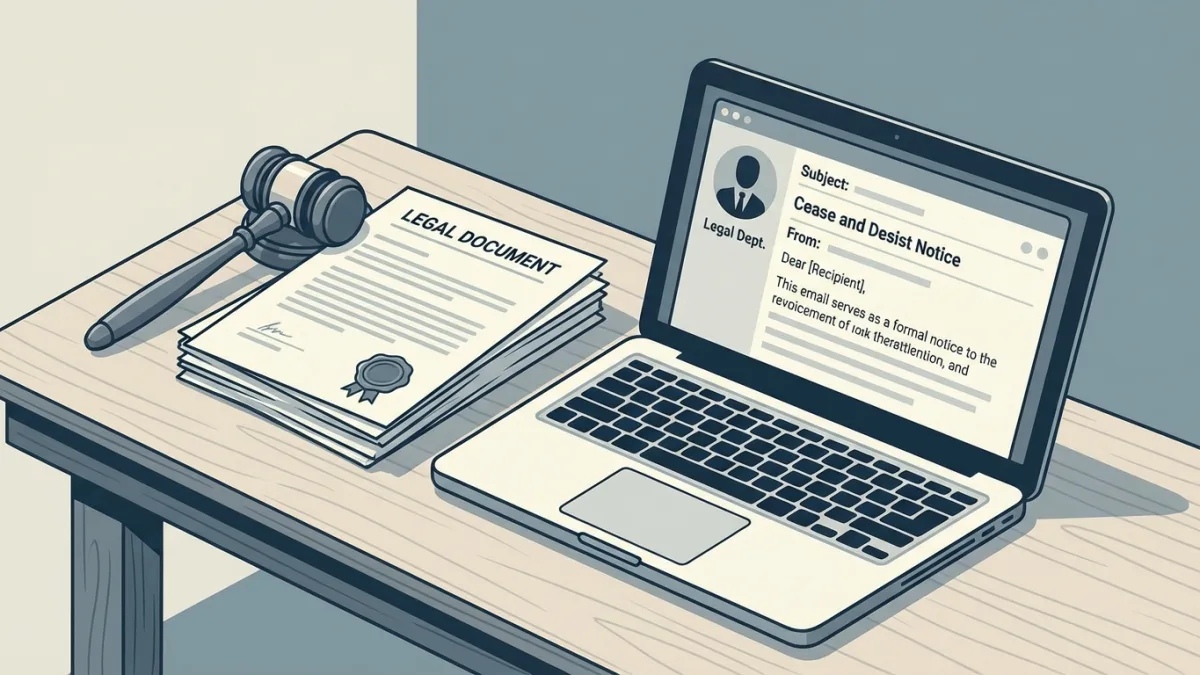
Step 3: Send a Cease and Desist Letter
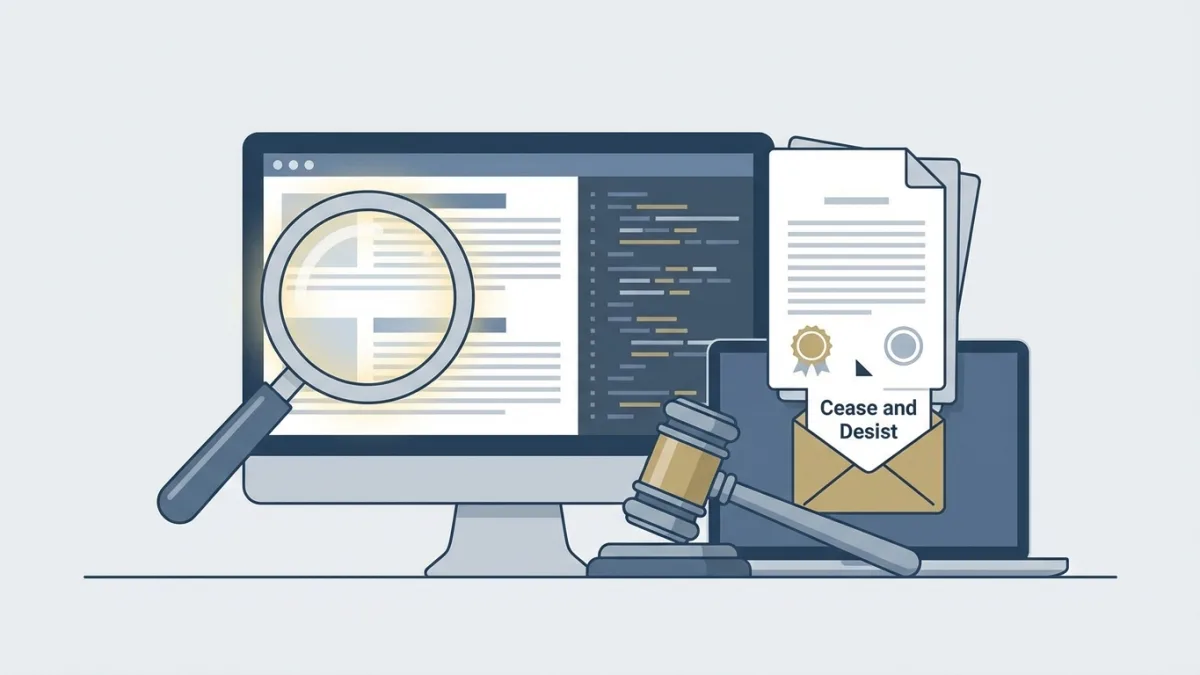
If the website owner ignores your initial email or outright refuses to comply, escalate the situation by sending a formal Cease and Desist letter. This document clearly outlines your rights, provides your proof of prior existence (such as attaching your Copyright01 PDF certificate), and states your intention to pursue further action if the content is not removed within a specific timeframe. For a comprehensive strategy on managing these disputes, read How to Fight Plagiarism and Infringement.
Step 4: File a DMCA Takedown Notice
If the website owner remains unresponsive, you can bypass them entirely by contacting their web hosting provider. Under laws like the Digital Millennium Copyright Act (DMCA) and similar international eCommerce regulations, web hosts are required to remove or disable access to infringing content when presented with proper evidence.
You can use tools like "WhoIs" hosting lookups to find out which company physically hosts the plagiarized website. Submit a formal takedown notice to the host's abuse or legal department, attaching your PDF certificate as proof of your original authorship. Additionally, you can submit a copyright removal request directly to search engines like Google to have the stolen page de-indexed from search results, effectively cutting off the plagiarist's organic traffic.
Expanding Your Protection Strategy
Protecting your main website is vital, but your content likely lives on multiple platforms. A comprehensive intellectual property strategy involves securing your digital assets wherever they are published and shared.
Secure Your Social Media Channels
Content theft is incredibly rampant on social media platforms. Your original videos, graphics, and written posts can be easily downloaded, slightly altered, and reposted by unauthorized accounts looking to build their own following. Copyright01 allows you to deposit content directly from major platforms, including YouTube, Instagram, and TikTok. Make sure you are also taking specific steps to secure your textual and visual updates by Protecting Your Facebook Content Copyright and learning how to Protect Your X Twitter Content Copyright.
Utilize Copyright Notices and Public Registries
Deterrence is a powerful tool in your anti-plagiarism arsenal. Always include a clear copyright notice in the footer of your website (e.g., "© [Year] [Your Company Name]. All rights reserved.") and maintain a detailed "Terms of Use" page that explicitly forbids unauthorized copying.
You can also add a badge or a link to your registered works to show visitors that you take your intellectual property seriously. By utilizing a Public deposit registry, you show potential thieves that your content is actively monitored and protected. If a third party wants to check the validity of your claims, they can easily Verify a certificate online, adding a layer of transparency and authority to your ownership.
Conclusion
Website plagiarism is an unfortunate reality of the modern digital age, but it does not have to be a permanent threat to your business. By understanding how to detect website plagiarism, utilizing the right monitoring tools, and establishing robust proof of prior existence with Copyright01, you can confidently assert your rights. Remember to document infringements carefully, communicate firmly with content thieves, and leverage web hosts and search engines when necessary. Protect your hard work today, so you can focus entirely on creating the innovative content of tomorrow.
Copyright01
Free copyright protection service. PDF certificate with SHA-256 fingerprint, recognised in 181 countries.