Learn how to protect your book before publishing. Discover essential steps, digital timestamping, and copyright strategies to secure your manuscript today.
Writing a book is a labor of love that often takes months or even years of dedication. Once your manuscript is finally complete, the excitement of sharing it with beta readers, editors, or literary agents can be overwhelming. However, before you send out a single chapter, you must know how to protect your book before publication.
Many authors assume that their work is entirely safe simply because they wrote it. While it is true that copyright is born the moment an original work is created, proving when you created it can be incredibly challenging without the right evidence. In the highly competitive publishing industry, securing your intellectual property is just as important as editing your final draft.
In this comprehensive guide, we will explore the essential steps to safeguard your manuscript, the tools available to establish proof of prior existence, and the common pitfalls you should avoid. If you are ready to take action immediately, you can create a free account to start securing your work today.
Why You Need to Protect Your Manuscript Early
The journey from a rough draft to a published novel is filled with vulnerabilities. Authors frequently share their unpublished works to gather feedback, seek representation, or collaborate with editors. Each time your manuscript leaves your personal hard drive, it enters an environment where your ideas, characters, and unique expressions could be exposed.
The Risks of Unprotected Sharing
When you share your work without establishing a clear paper trail, you open yourself up to potential disputes. Imagine sending your manuscript to a prospective publisher or a freelance editor, only to find a suspiciously similar story published a year later. Without concrete evidence of your authorship at a specific point in time, fighting such an infringement becomes an uphill battle.
⚠️ Warning: Sharing unprotected drafts can lead to unauthorized copying or idea theft. Always establish proof of creation before distributing your manuscript.
Understanding why register your copyright? is the first step toward peace of mind. Registration provides a clear, recognized record that you possessed the work on a specific date, which is crucial if you ever need to assert your rights.
Establishing Proof of Prior Existence
In copyright disputes, the core argument usually revolves around two factors: originality and priority. You must show that your work is original and that it existed before the alleged infringing work. This concept is known as "proof of prior existence."
Having a reliable method to prove your timeline is essential. This is where modern digital solutions outshine outdated methods, providing robust evidence that can be presented in case of a conflict.
Essential Steps to Secure Your Book
Protecting your book before publication requires a proactive approach. By implementing these essential steps, you can significantly reduce the risk of intellectual property theft.
1. Keep Meticulous Digital Records and Drafts
Long before you finish your book, you should be documenting your progress. Save multiple versions of your manuscript as it evolves from an outline to a final draft. Keep your research notes, character sketches, and world-building documents. These files serve as foundational evidence of your creative process.
Ensure that these files are backed up securely. However, keep in mind that file creation dates on a personal computer can easily be altered, meaning they offer weak evidence on their own.
2. Use Non-Disclosure Agreements (NDAs)
When sharing your manuscript with beta readers, freelance editors, or cover designers, it is wise to use a Non-Disclosure Agreement. An NDA establishes a confidential relationship, explicitly stating that the recipient cannot share, copy, or use your work without permission.
If you need help drafting these documents, you can utilize resources like LegalGen: Free Legal Templates for Your Work to create customized agreements suited to your specific needs.
3. Register Your Copyright Digitally
The most effective way to secure your manuscript is through a digital copyright deposit. This process involves uploading your text file to a secure platform that generates a digital timestamping record and a unique SHA-256 fingerprint of your file.
This method locks in the exact state of your document at that precise second. If you are unsure which method suits you best, consider reading our guide Comparing 5 Proof of Prior Existence Methods to understand the landscape of available options.
Comparing Copyright Protection Methods
Authors have historically relied on various methods to protect their work. However, not all methods offer the same level of security and recognition. Let's compare the most common approaches.
| Protection Method | Cost | Speed | Proof Quality | International Recognition |
|---|---|---|---|---|
| Poor Man's Copyright (Mailing to oneself) | Low | Slow | Weak | Poor |
| Soleau Envelope (Physical mail deposit) | Moderate | Slow | Moderate | Mostly National |
| Copyright01 Digital Deposit | Low (Free initially) | Instant | Strong | High (181 Countries) |
The Downfall of Traditional Methods
Many writers still believe in the "Poor Man's Copyright"—the practice of mailing a sealed copy of the manuscript to oneself. This method is highly problematic because envelopes can be unsealed and resealed, making the postmark date unreliable evidence.
Similarly, physical deposit systems like the Soleau envelope are geographically limited and cumbersome. For a deeper dive into why digital methods are superior, read our article on the Soleau Envelope vs Modern Digital Registration.
The Berne Convention Advantage
When you publish a book, it enters a global market. Therefore, your protection should be global as well. Thanks to the Berne Convention, an international treaty governing copyright, works are protected across borders.
When you use a reliable digital deposit service, your proof of prior existence is recognized in 181 countries. This means that whether your book is plagiarized in your home country or across the world, you have the documentation needed to defend your rights. Learn more about this in our guide on Berne Convention Global Copyright Protection.
💡 Tip: Always ensure your copyright strategy accounts for international exposure, especially if you plan to publish as an eBook accessible worldwide.
How to Register Your Book with Copyright01
Securing your manuscript is straightforward with Copyright01. Our platform is designed specifically for creators who need fast, reliable, and accessible proof of prior existence.
A Simple, Step-by-Step Process
- Prepare Your File: Save your completed manuscript or current draft as a PDF, Word document, or plain text file.
- Upload: Log into your Copyright01 account and upload the file. We accept various deposit types, including text, image, audio, video, and even source code.
- Timestamping: The moment your file is uploaded, it undergoes digital timestamping. A unique SHA-256 fingerprint is generated, linking your specific file to that exact date and time.
- Secure Storage: Your file is protected using server-side AES-256 encryption. Your deposits are preserved for a minimum of 10 years, ensuring long-term availability of your proof.
Flexible Pricing for Every Author
We believe that copyright protection should be accessible to all writers. Copyright01 offers 3 free deposits for new users. After that, you can purchase credit packs starting from just EUR 4.90, or opt for a subscription at EUR 9.90/month or EUR 79/year for high-volume creators.
What You Get After Depositing
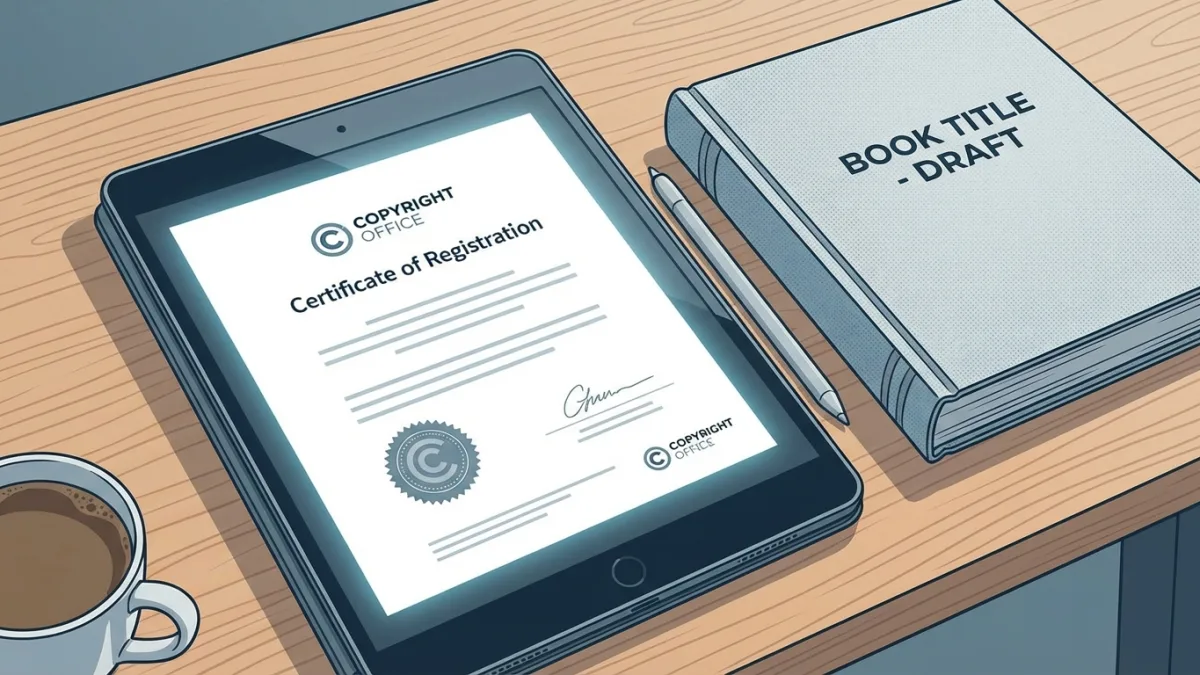
Once the process is complete, you receive a detailed PDF certificate containing the SHA-256 fingerprint and the digital timestamping data. You can easily verify a certificate at any time to demonstrate your prior rights to a publisher or in a dispute.
Additionally, you have the option to list your work in our public deposit registry, adding an extra layer of visibility to your claim of authorship.
Common Mistakes Authors Make Before Publishing
Even well-intentioned authors can make errors that jeopardize their intellectual property. Here are some critical mistakes to avoid before your book hits the shelves.
Failing to Protect Collaborative Elements
Books are rarely created in a vacuum. You might hire a freelance artist for your cover or a formatter for your interior layout. It is crucial to clarify who owns the copyright to these elements. To understand how this applies to visual assets, review our guide on Copyright for Freelance Graphic Designers.
Ignoring AI and Plagiarism Threats
The rise of artificial intelligence has complicated the copyright landscape. If you use AI to assist in writing or brainstorming, you must understand how this affects your ownership rights. Read our comprehensive breakdown: AI Content and Copyright Rules Explained.
Furthermore, once your book is published, the risk of digital piracy increases. You must be vigilant. Learn how to Detect Website Plagiarism and Take Action to ensure your text isn't being scraped and sold elsewhere.
📋 Key takeaway: Protection doesn't stop at publication. Knowing How to Fight Plagiarism and Infringement is a necessary skill for modern authors.
Relying on Outdated Advice
As mentioned earlier, mailing yourself a copy of your book is ineffective. Relying on such myths is one of the 10 Critical Copyright Mistakes that can leave your work entirely unprotected. Always use modern digital timestamping to secure your files.
Securing Your Literary Legacy
Your manuscript represents your unique voice, countless hours of labor, and your potential future income. Learning how to protect your book before publication is not just a legal formality; it is a fundamental part of the professional writing process.
By keeping meticulous records, utilizing NDAs when necessary, and securing your work with a digital deposit, you build a strong foundation of proof. With your PDF certificate, SHA-256 fingerprint, and digital timestamping in hand, you can confidently share your manuscript with the world.
Don't leave your hard work vulnerable to theft or disputes. Take control of your intellectual property today and focus on what you do best: writing incredible stories.
Copyright01
Free copyright protection service. PDF certificate with SHA-256 fingerprint, recognised in 181 countries.